
Sales@mightools.com
+86-28-86736065
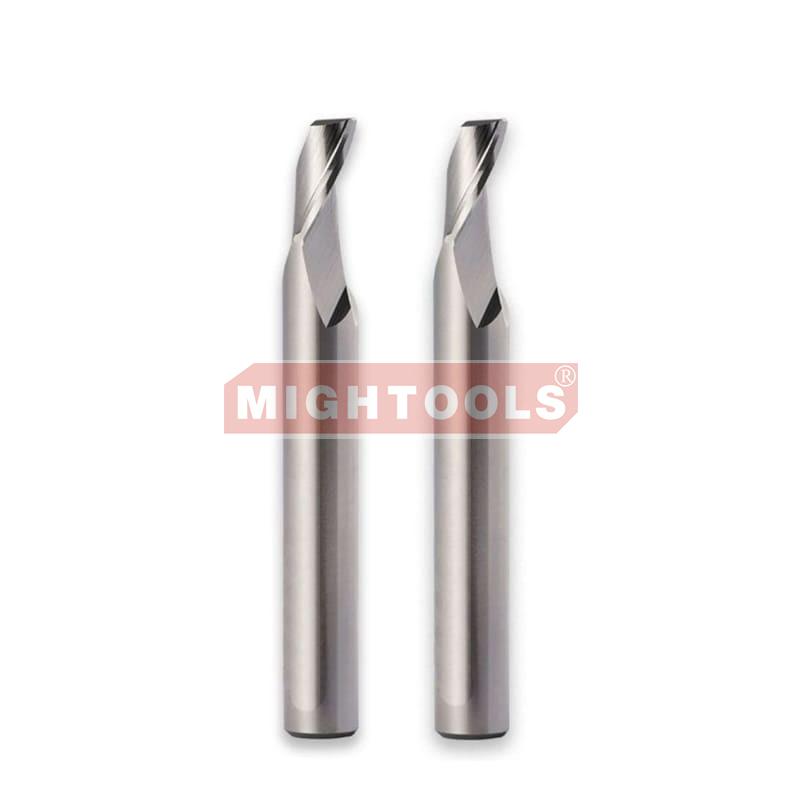
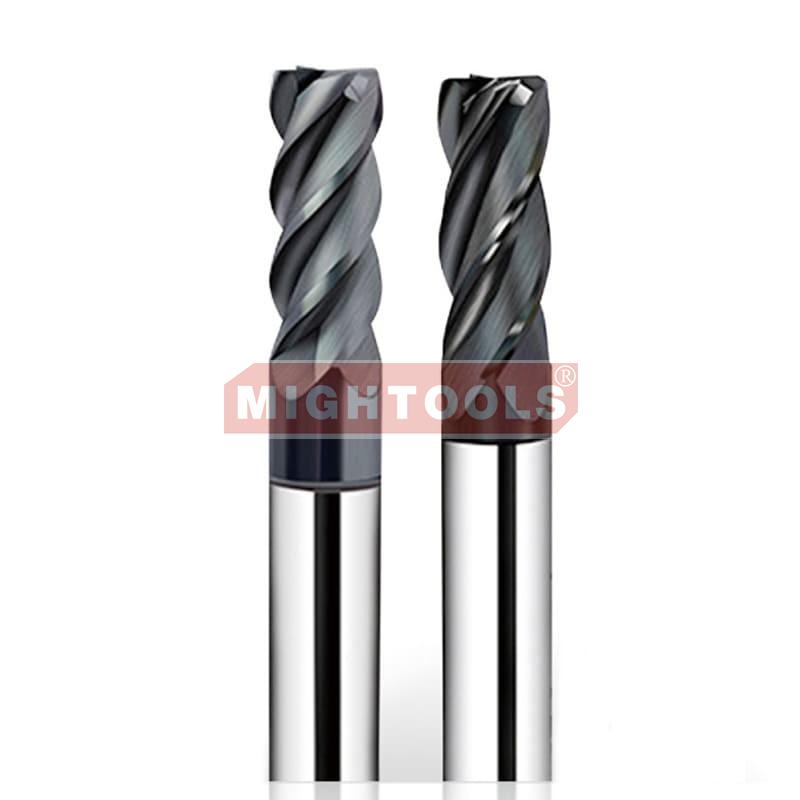
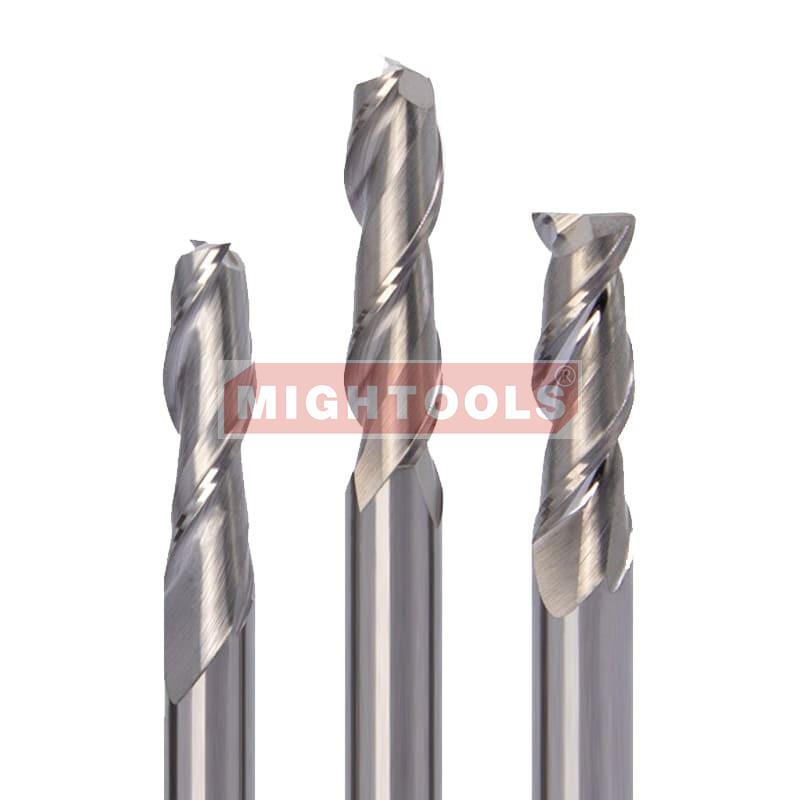
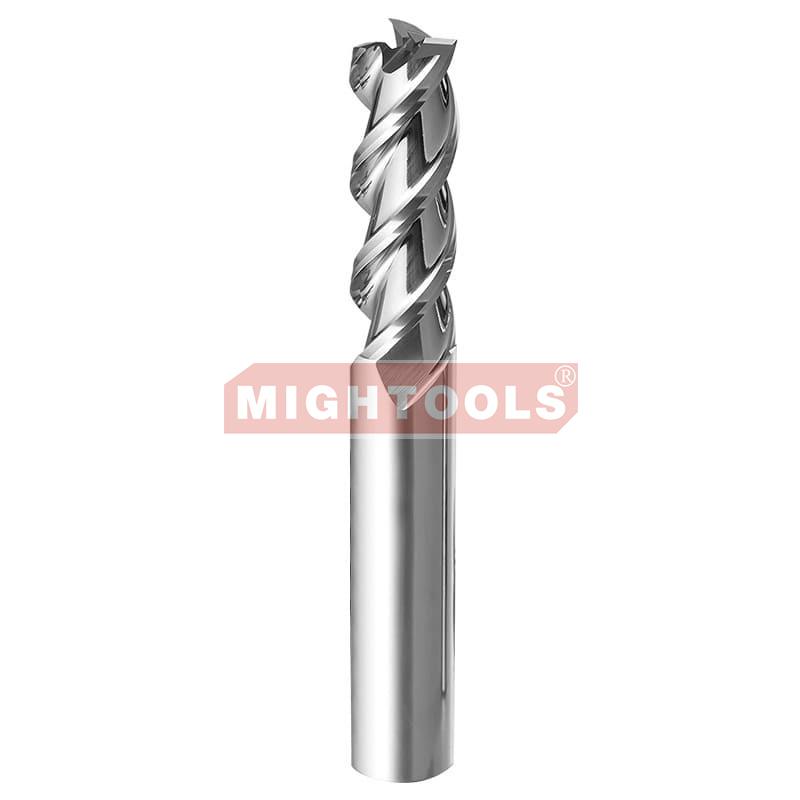
HSS End Mill
Material:HSSM2,HSS M35,HSSM42,HSS PM.
Classification and Applications of End Mills
| Tool Type | Key Features | Primary Applications |
|---|---|---|
| Square / Flat-End Mill | Has a square tip with sharp 90° corners, capable of producing flat bottoms and vertical side walls. It is the most versatile type. | Used for milling flat surfaces, shoulders, square slots, and keyways. It is the most widely applied type. |
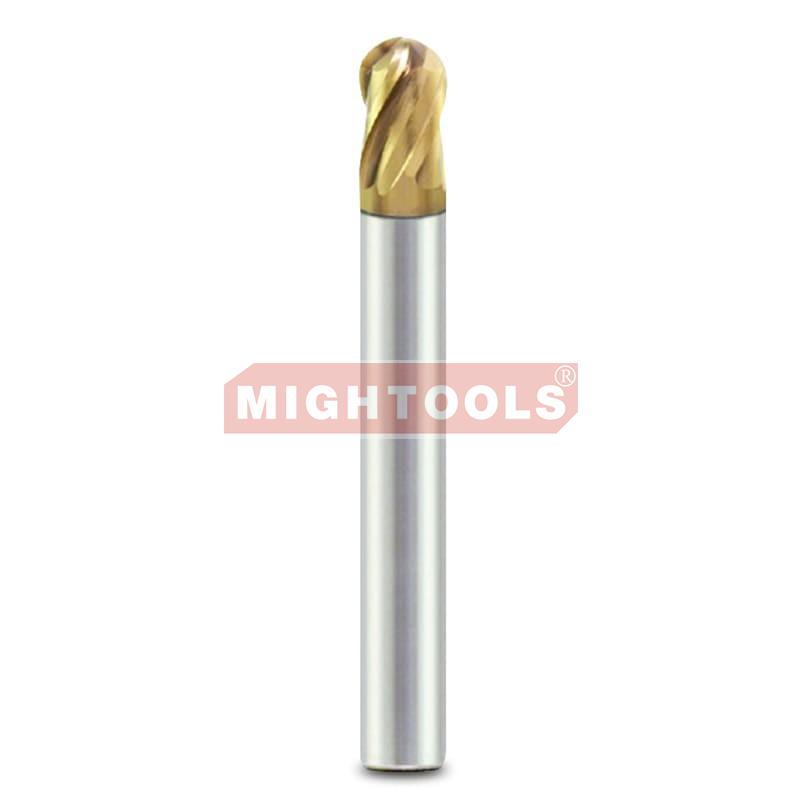
| Ball-Nose End Mill | Features a hemispherical tip. It is the first choice for 3D surface machining. | Used for machining mold cavities, complex curved surfaces, engraving, and 3D contours. Also suitable for machining rounded-bottom slots. |
| Corner-Radius End Mill | Has a rounded corner (radius) at the tip, combining the rigidity of square end mills with some contouring capability of ball-nose types. | Used for roughing and semi-finishing, especially in applications where edge strength needs to be improved to prevent chipping, or where the workpiece requires a transition radius at corners. |
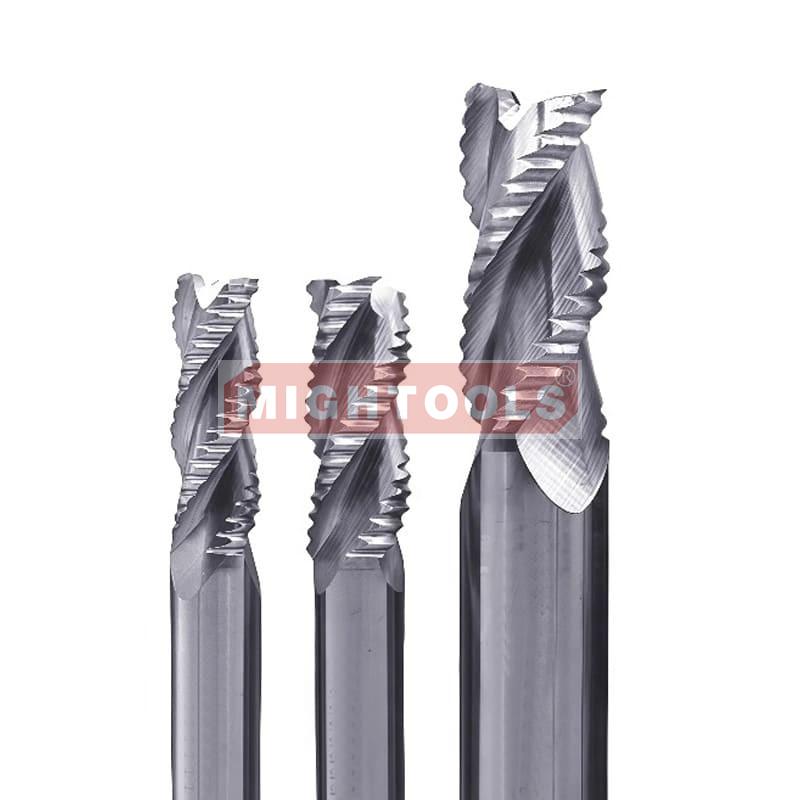
| Roughing End Mill | Features serrated or chip-splitting Cutting edges that break chips into smaller pieces, reducing cutting resistance. | Specifically designed for high-efficiency roughing with large stock removal. Surface finish is not a primary concern. |
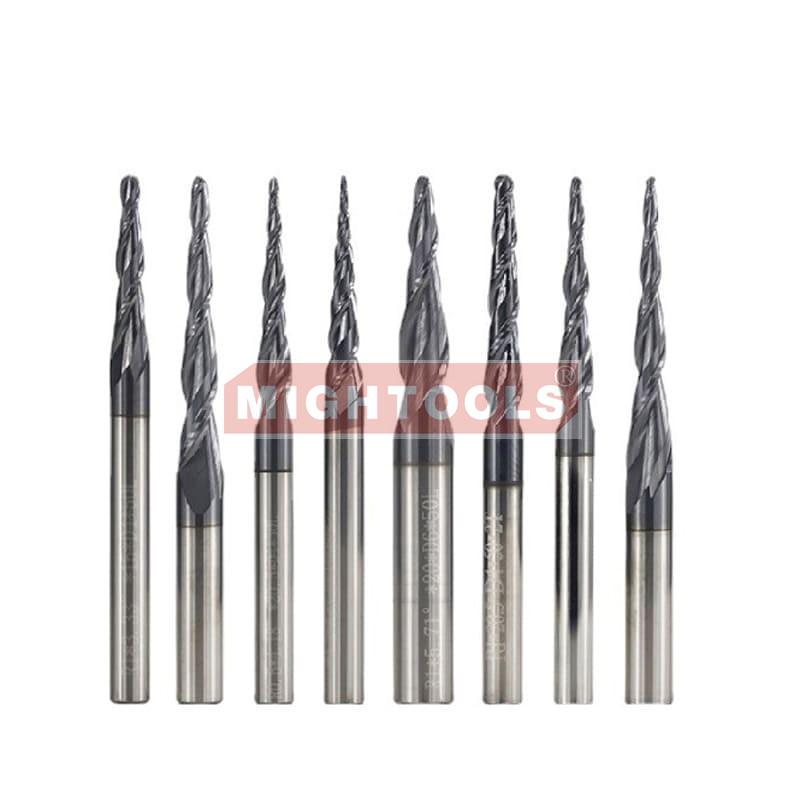
| tapered End Mill | Has a tapered cutting portion (e.g., 0.5°–25° per side). | Mainly used in mold making to create draft angles, or for machining inclined side walls. |
| Forming End Mill | Cutting edge shape matches the final workpiece contour. | Used for machining specific profiles such as T-slots, dovetail slots, gear tooth forms, etc. |
In addition to shape-based classification, the number of flutes is also an important selection criterion. For roughing or machining materials that produce long chips (e.g., aluminum alloys), 2-flute or 3-flute end mills are often preferred for their larger chip evacuation space. For finishing or machining ferrous metals, 4-flute or more end mills provide better rigidity and surface finish.
End mills are highly flexible in their machining methods. Utilizing both their end cutting edges and peripheral cutting edges, they can perform a variety of tasks:
Typical Machining Operations: Include face milling, slotting, shoulder milling, cavity machining, and contour/profile milling. Some specially designed 2-flute end mills can even perform vertical plunging/ramping like a drill for initial entry.
Major Application Industries: Widely used in mold making (machining cores and cavities), aerospace (machining aluminum structural components), automotive manufacturing (engine and transmission housings), and precision electronic parts machining.
Choose Square/Flat-End: For machining right-angle shoulders, flat surfaces, and slots.
Choose Ball-Nose: For machining 3D curved surfaces and complex contours.
Choose Corner-Radius: For improved strength and durability during roughing.
Choose Roughing End Mill: For rapid removal of large material volumes.
Other Related Mills
| Tool Type | Typical Features | Primary Applications |
|---|---|---|
| Slitting Saw / Slotting Cutter | Resembles a circular saw blade—thin and sharp, with cutting edges on the periphery. | Specifically used for cutting off bars, tubes, and profiles, as well as machining narrow and deep slots, such as screw head slots. |
| Face Mill | Larger diameter, with cutting edges on both the end face and the periphery. | Primarily used on horizontal or vertical milling machines for milling large flat surfaces, offering high machining efficiency and good surface finish. |
| Forming Cutter | Cutting edge shape matches the final workpiece contour—examples include T-slot cutters, gear cutters, etc. | One-pass machining of complex specialized contours such as T-slots, gear tooth profiles, etc., with extremely high efficiency. |
Additionally, cutters can be made as different coating (e.g., TiN, TiAlN,ZrN,TiSiN,AlTiSiN), which further enhances wear resistance and heat resistance.
Contact: Luoxu
Phone: +86-13438285256
E-mail: Sales@mightools.com
Whatsapp:+86-13438285256
Add: 7F,No.2,Tongfu Alley,Xiyulong ST.,Chengdu 610015,China
We chat
